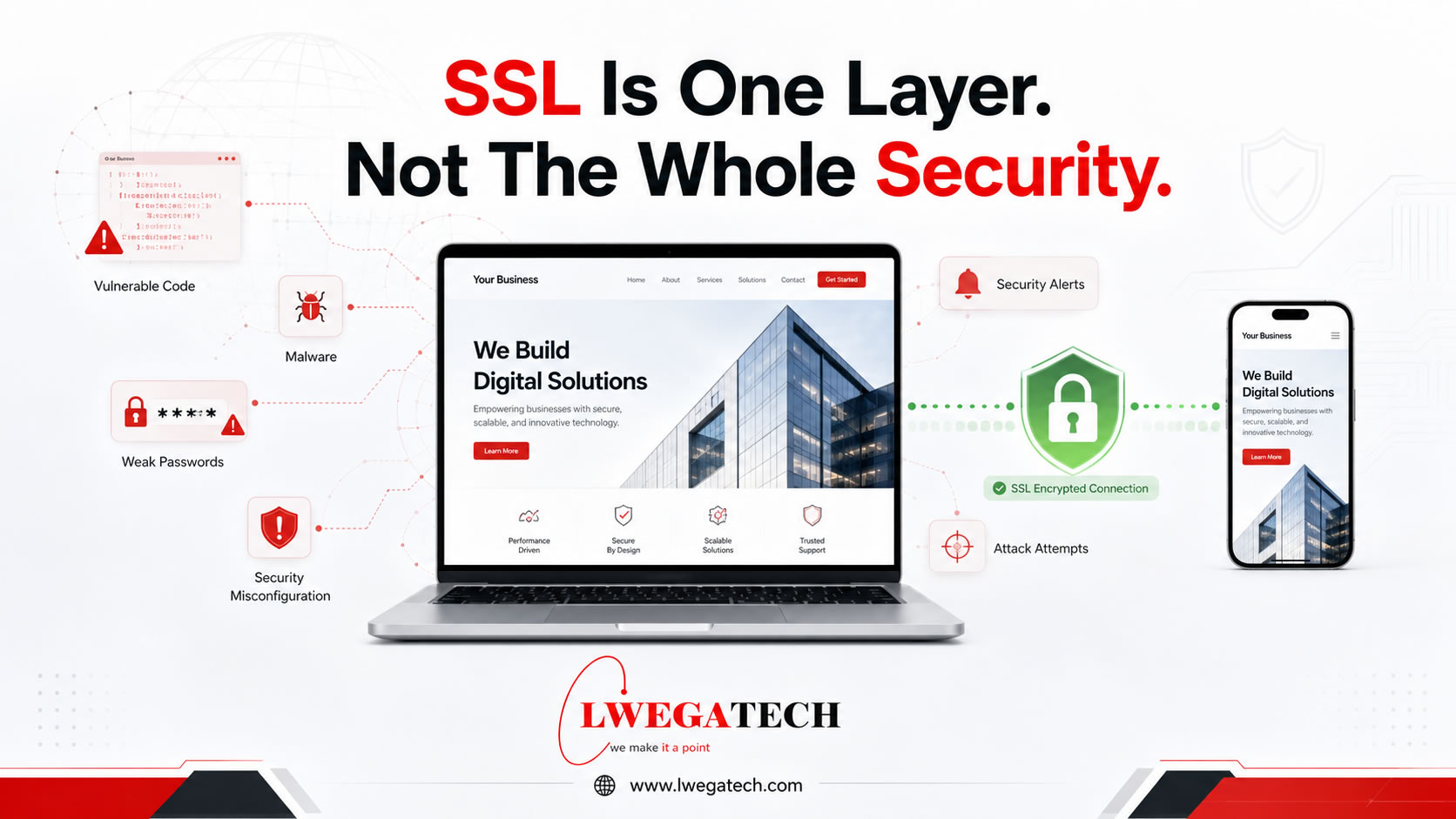
SSL certificates are an important part of website security, but they are often misunderstood.
Seeing the 🔒 padlock in a browser can easily give the impression that a website is completely secure. In reality, the padlock only confirms one specific layer of protection.
It does not mean that the website cannot be hacked, infected with malware, exploited through vulnerable code, or compromised through weak passwords.
Understanding this difference is important for every website owner.
So, what exactly is an SSL Certificate?
SSL stands for Secure Sockets Layer. Modern websites technically use its successor, TLS, although the term SSL certificate is still commonly used.
Its primary job is simple:
To encrypt data as it travels between your website and your visitor.
Think of it like sending an important package.
Without SSL, the package travels openly, and someone along the way could potentially look inside.
With SSL, the package is securely locked before it leaves and can only be opened by the intended recipient.
The journey is protected.
But this is where an important distinction comes in:
SSL protects the journey. It does not inspect or secure everything inside the website itself.
If a website already contains vulnerable code, malware or a compromised application, SSL can still securely transmit that content to the visitor.
What SSL does protect
✅ Encrypts information during transmission.
✅ Protects passwords and login credentials while they are being transmitted.
✅ Helps prevent data interception between the visitor and the website.
✅ Enables HTTPS and helps establish trust with website visitors.
What SSL does NOT protect
❌ It does not stop attackers from exploiting vulnerable website code.
❌ It does not detect or remove malware.
❌ It does not prevent all denial-of-service attacks.
❌ It does not replace regular software updates and security patches.
❌ It does not protect accounts that use weak or compromised passwords.
❌ It does not replace secure website development and server configuration.
Website Security Requires Multiple Layers
Website security is never achieved through a single certificate, plugin or security product.
A properly secured website depends on several layers working together.
At LWEGATECH, website security may include measures such as:
- SSL Certificates
- Web Application Firewalls (WAF)
- Malware scanning
- Regular software updates and patching
- Secure coding practices
- Strong passwords and access controls
- Website and server backups
- Disaster recovery planning
- Server and website monitoring
Each layer addresses a different type of risk.
SSL protects information while it is travelling.
A firewall helps control potentially malicious requests.
Updates close known software vulnerabilities.
Malware scanning helps detect suspicious files.
Backups give you a recovery point when something goes wrong.
Monitoring helps identify unusual behaviour before it becomes a larger incident.
That is why effective website security should always be approached as a strategy, rather than as a single product.
The padlock in your browser is important.
But it is only one piece of the website security puzzle.
Is Your Website Really Secure?
Having HTTPS enabled is a good start, but website owners should also regularly review the security of the website itself, its applications, hosting environment, user accounts and backups.
LWEGATECH provides website development, hosting, maintenance and security support for businesses and organizations.
If you would like your website or hosting environment reviewed, visit Our offices and talk to our technical team.