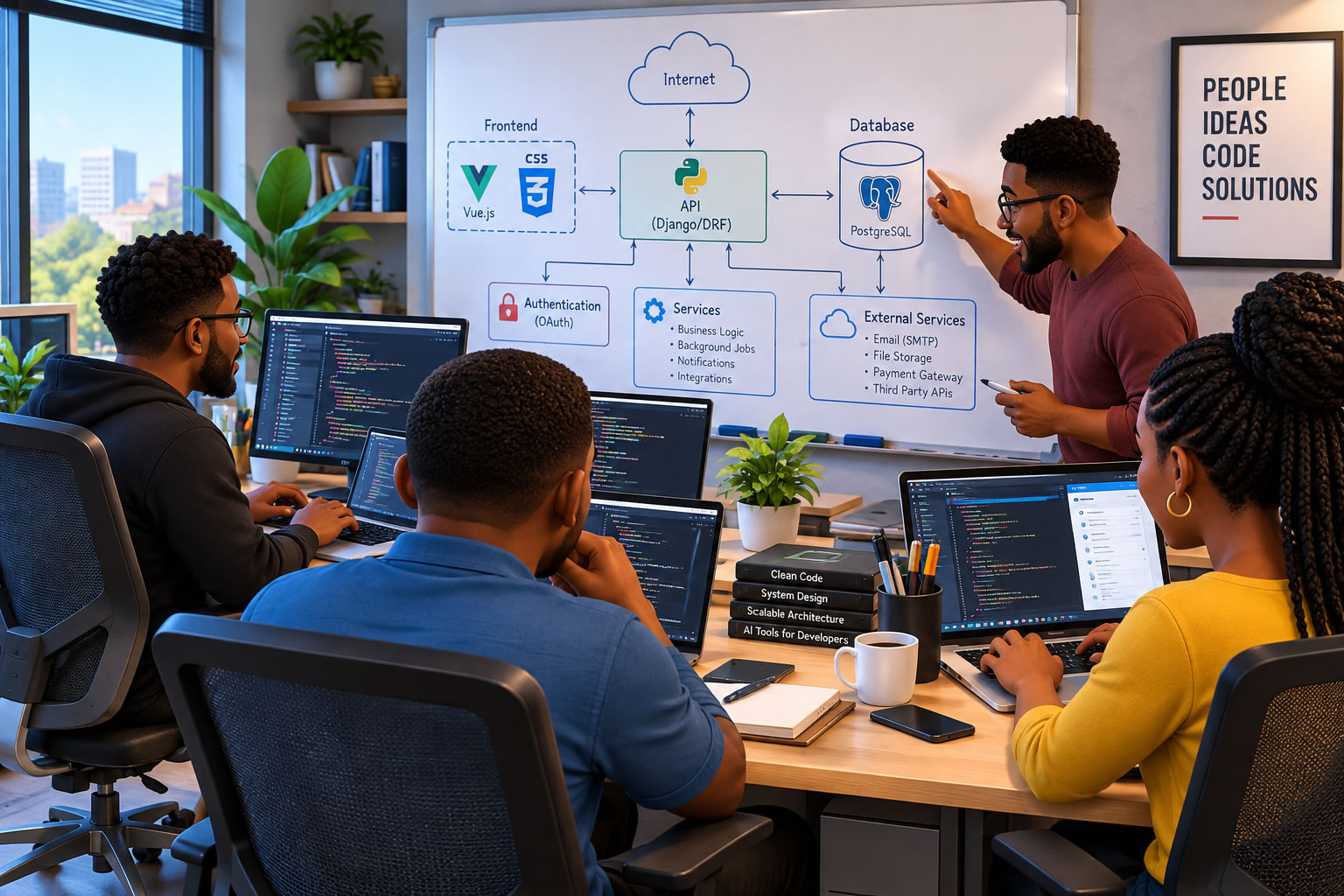
Artificial intelligence is rapidly changing software development. Code that previously took hours to write can now be generated in minutes. Developers can use AI to debug applications, explain unfamiliar technologies, generate tests, document systems and even propose complete software architectures.
It is therefore understandable that one question continues to emerge: if AI can already write code, will software developers still be needed?
The answer lies in understanding what professional software development actually involves.
Writing code is only one part of building software. A working application requires someone to understand the problem, translate business requirements into technical solutions, make architectural decisions, evaluate risks, integrate different technologies and ensure that the final system is secure, scalable, maintainable and useful to the people it was designed for.
As AI becomes better at producing code, these abilities may actually make good developers more valuable, not less.
AI Can Write Code. But Code Is Not the Entire System.
Modern AI tools can already generate impressive amounts of functional code. Give an AI tool a sufficiently clear requirement and it can create models, APIs, user interfaces, database queries, tests and documentation within seconds.
That capability is significant, but producing code and building a reliable software system are not the same thing.
Before development begins, someone must understand what is being built and why. Business processes must be understood, requirements clarified, workflows designed and technical constraints identified.
During development, decisions must be made about architecture, databases, APIs, authentication, permissions, infrastructure, integrations, performance and security.
And after the code has been produced, someone still needs to determine whether it is actually correct.
That is where developer expertise becomes increasingly important.
Someone Must Know When AI Is Wrong
One of the greatest advantages experienced developers have when working with AI is not simply their ability to generate better prompts.
It is their ability to evaluate the response.
AI can confidently suggest code that works but introduces a security vulnerability. It can propose an architecture that appears reasonable but will become difficult to scale. It can generate a database query without understanding its effect on a large production database.
It can also solve the technical question it was asked while completely missing the larger business problem.
A developer who understands the fundamentals can recognize these problems.
The ability to ask AI for a solution is useful. The ability to know whether that solution should be implemented is considerably more valuable.
Software Development Requires Context
Every serious software project exists within a wider environment.
There are users with different permissions and expectations. There are business rules that may not be obvious from the interface. There are existing systems that need to communicate with the new application. There are security requirements, infrastructure limitations, budgets, deadlines and future growth to consider.
A technically correct piece of code can therefore still be the wrong solution.
Professional developers bring context into the development process. They understand how one technical decision affects another part of the system and how decisions made today may affect maintainability several years later.
AI can provide options.
The developer remains responsible for understanding the consequences of choosing among them.
Architecture Will Matter More, Not Less
As producing individual pieces of code becomes faster, understanding how those pieces should work together becomes increasingly important.
A developer may use AI to help build a frontend, API endpoint or database query, but the larger questions remain:
- How should the application be structured?
- Where should particular business logic live?
- How should authentication and authorization work?
- How should data be stored and protected?
- How should external services be integrated?
- What happens when one component fails?
- How will the application scale?
- How will another developer understand and maintain the system later?
- These are architectural questions rather than simply coding questions.
The faster AI enables teams to build, the more important good architectural decisions become.
Security Cannot Be Delegated Blindly to AI
Security provides another good example of why technical knowledge remains important.
Generated code may function perfectly during testing while still exposing sensitive information, incorrectly implementing permissions, introducing vulnerable dependencies or creating weaknesses that only become apparent under particular conditions.
Developers therefore need to understand secure coding, authentication, authorization, infrastructure, databases and application security well enough to review what AI produces.
AI can assist with security reviews and identify potential vulnerabilities, but accountability for deploying secure systems ultimately remains with the people and organizations building them.
Good Developers Will Produce More
Perhaps the biggest change AI brings to software development is productivity.
A capable developer who previously spent several hours researching an unfamiliar implementation can now use AI to understand the concept, compare approaches and begin testing possible solutions much faster.
Repetitive code can be generated. Documentation can be drafted. Test cases can be proposed. Errors can be investigated more quickly.
This means developers can spend more of their time on higher-level activities such as architecture, problem-solving, reviewing implementations and understanding business requirements.
The result is not necessarily fewer valuable developers.
It can mean more capable developers producing significantly more value.
Fundamentals Become More Important in the AI Era
There is, however, an important distinction.
AI may make it easier for someone with limited technical knowledge to produce code, but producing code without understanding it creates another problem.
If a developer cannot explain what generated code does, cannot identify why it has failed and cannot evaluate whether it is secure or appropriate, AI has created dependency rather than capability.
Understanding programming fundamentals, databases, networking, system architecture, APIs, security and infrastructure therefore remains important.
Developers need that knowledge not only to create systems themselves, but increasingly to review, direct and improve what AI creates.
The Developer’s Role Is Changing
The software developer of the AI era may spend less time manually producing every line of code.
Instead, more time may be spent understanding requirements, designing systems, directing AI tools, reviewing generated implementations, integrating components, testing assumptions and making technical decisions.
That represents an evolution of the profession rather than its disappearance.
The strongest developers will not be those who refuse to use AI, nor those who simply accept everything AI generates.
They will be developers who combine technical knowledge, problem-solving ability, business understanding and professional judgment with the productivity that AI provides.
AI Is an Amplifier
Every major advancement in technology changes the tools available to professionals.
AI is doing the same for software development, but at a remarkable speed.
It can generate code, explain concepts, identify problems and dramatically accelerate development. What it does not remove is the need to understand what should be built, why it should be built, how the pieces should work together and whether the resulting system can be trusted.
That is why good developers may become even more valuable in the AI era.
Not because they will compete with AI at writing code, but because they will know how to use AI to build better systems, faster while providing the technical judgment, context and accountability that professional software development still requires.
AI does not replace good developers. It amplifies them.