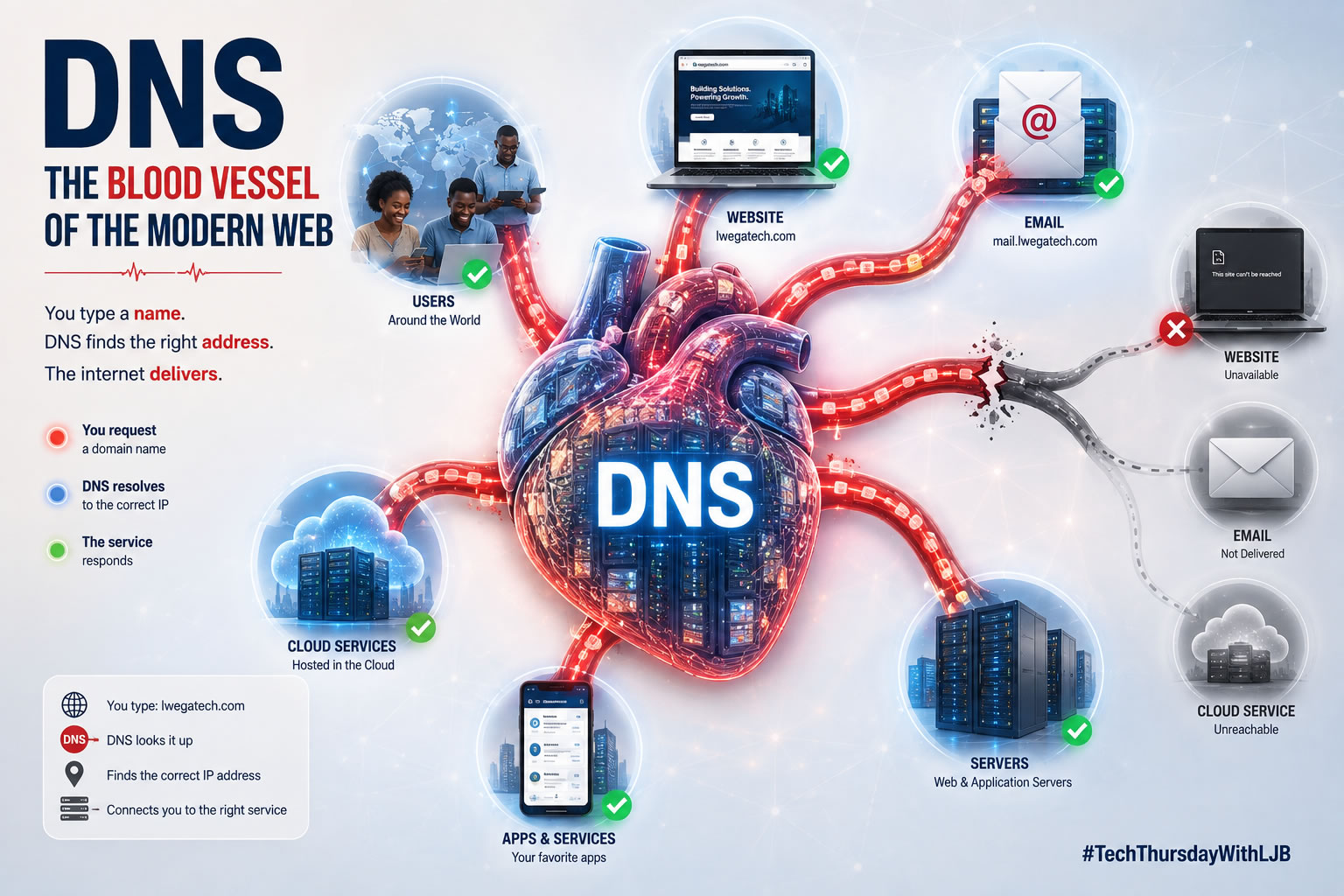
It’s fascinating how something that looks so simple holds so much power over how the internet works.
DNS — Domain Name System.
In 1983, Paul Mockapetris designed DNS while working at the Information Sciences Institute (ISI) at the University of Southern California.
The problem he was helping solve was fairly straightforward.
As networks grew, keeping one central list matching computer names to their addresses was becoming increasingly difficult to manage.
There had to be a better, more organized and scalable way of doing it.
DNS became that solution.
And I sometimes wonder whether anyone at the time imagined just how important that system would eventually become to the internet we use today.
Let me bring DNS down to everyday language.
Take a domain like:
lwegatech.com
As humans, that’s easy to remember.
Imagine instead telling someone:
“Visit my website. The address is 192.xxx.xxx.xxx.” 😂
Now imagine having to remember numbers like that for Google, Facebook, your bank, your favorite news site and every other website you visit.
It would be a nightmare.
Computers, however, need network addresses to know where to send requests.
That’s where DNS comes in.
Think of it like the internet’s phonebook or contact list.
You know the person’s name: Joseph.
Your phone knows the number associated with Joseph.
You tap Joseph…and the phone handles the rest.
DNS does something similar.
You type: lwegatech.com
DNS helps your device find the IP address associated with the service you’re trying to reach.
And all that happens behind the scenes before you start interacting with the website.
Of course, there’s plenty of magic underneath.
We configure things like:
- Nameservers.
- DNS zones.
- A records.
- MX records.
- CNAMEs.
- TXT records.
These records help determine where your website lives, where your email should go, and how different services connected to your domain should behave.
And then there’s another word you’ll often hear your tech person mention:
Propagation.
“We have made the DNS changes. Now we need to wait for propagation.” 😂
What exactly are we waiting for?
In simple terms, when DNS information changes, that new information isn’t necessarily seen everywhere on the internet immediately.
Different DNS resolvers may still have the old information cached for some time.
As those cached records expire and fresh information is requested, more users begin receiving the new DNS information.
That’s what we commonly refer to as DNS propagation.
Sometimes you’ll see the change within minutes.
Other times it takes longer depending on things like caching and the TTL settings on the DNS records.
That’s why you will often hear us say: “Give it up to 24 hours.”
DNS is one of those technologies most people never think about… until something goes wrong.
Your server can be perfectly healthy.
Your website files can be intact.
Your application can be running.
Your email server can be ready.
But if DNS isn’t correctly directing traffic to those services… to the outside world, they may as well not exist.
That’s why I like thinking of DNS as one of the blood vessels of the modern web.
You rarely notice it when everything is flowing correctly.
But interrupt the flow…and suddenly you realize just how much depends on it.
So next time your tech guy mentions DNS, nameservers, records or propagation in the same conversation…don’t worry. 😂
He’s probably just making sure the blood is flowing to the right places.